In conversation with our founder - Part Four:
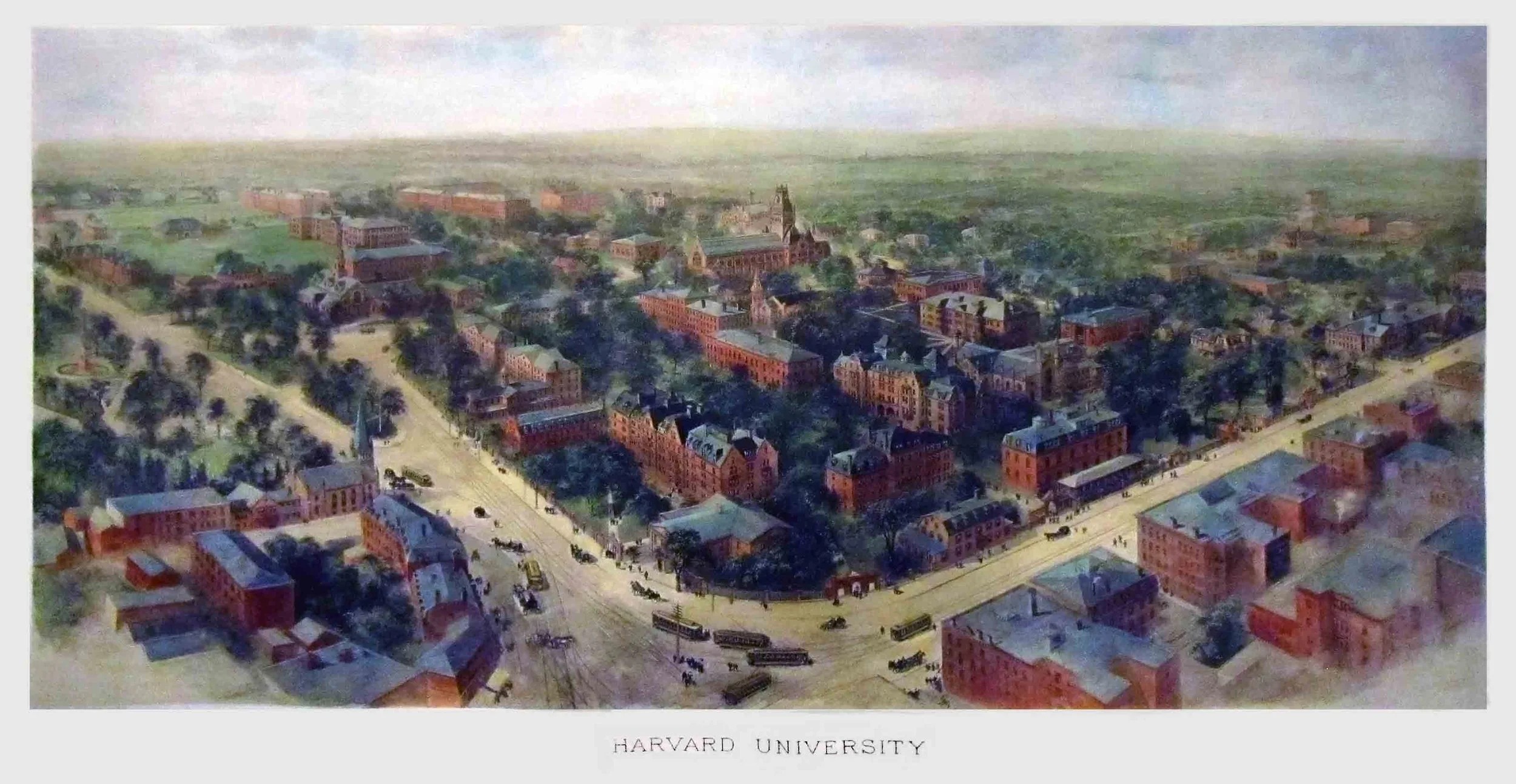
A 1906 aerial watercolor portrait of Harvard University, by Richard Rummell
From "Not Smart" to Harvard — and Why It Matters for Joy Lab Academy
I want to tell you something I don't always lead with, but that I think is essential to understanding why I built the Joy Lab Academy the way I did.
When I was in elementary school — and honestly, into high school — I knew I was smart. I knew it in the way kids just know things about themselves. But my teachers didn't know it. My schools didn't know it. I was living with dyslexia and undiagnosed ADHD, and rather than being seen as the curious, capable kid I was, I was treated as slow. As not smart. That experience left a mark.
So when I decided to pursue a master's degree, one of my motivations was — I'll be honest — purely superficial. I wanted to prove them wrong. There's actually a funny postscript to that: a friend of mine had an aunt who had been a teacher at my high school. After word got around that I'd been accepted to Harvard, she told me people were saying, I always knew Ken could do it. I had to laugh. No, they didn't. They absolutely did not think I could do it. But I did it anyway.
What I didn't expect was how completely I would fall in love with the experience once I arrived. I went in dragging my feet. Three days into being on campus, I felt like I'd found a home. People actually started joking that I never left — and they weren't entirely wrong. I was at the library constantly, not because I had to be, but because I wanted to be. I ended up founding two organizations while I was there: one focused on men in education (at the time, roughly 76% of educators were women, and the Harvard Graduate School of Education reflected that), and the Experiential Educators Network, which I'm proud to say I believe is still active today. I was busy, energized, and fully alive in that environment in a way I hadn't expected.
The professors were wonderful. But if I'm being truthful about what I took away most from Harvard, it was my fellow students. There was such a remarkable, diverse group of highly intelligent and driven people — all using education as a vehicle to change the world. Being surrounded by that community, participating in it so fully, validated something deep in me that my early teachers had tried to take away.
And that's exactly why it matters for the Joy Lab Academy.
Yes, the degree looks good on paper. But what it really gave me was the lived experience of being underestimated, of proving myself, and of thriving in an environment that saw my potential. I know what it feels like to be a kid whose intelligence isn't recognized by the system around them. I know what it feels like when a learning environment finally clicks — when you feel seen, challenged, and free to grow. That's not something you get from waking up one day and deciding to open a learning center. That's something forged over a lifetime of being a student, an outdoor educator, a founder, and a father.
Every choice we're making at the Joy Lab Academy — the child-centered philosophy, the self-directed learning, the carefully selected teachers, the commitment to joy — is informed by all of it. Including, maybe especially, the kid who was told he wasn't smart, and refused to believe it.
